AI Keyword Clustering Tool
Paste up to 300 keywords and get them grouped into topic clusters, each with a pillar keyword and search intent. 1 free prompt a day, 20 with a free account.
Cluster keywords freeA keyword cluster is a group of searches that one page can target together. Grouping a long keyword export by hand takes hours; clustering does it in one step.
Below: how to run it, how to clean your list first, an example of what good clusters look like, and how to turn clusters into pages without making your own pages compete.
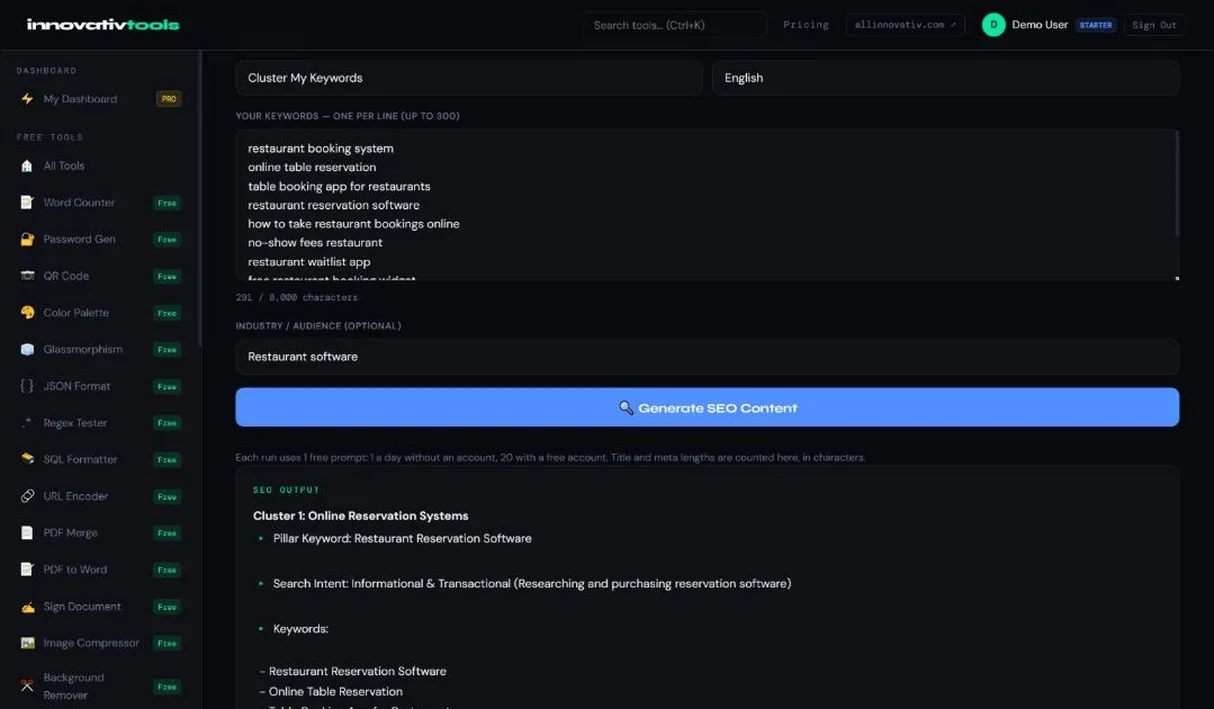
How to cluster keywords with AI
- Export your keywords from Google Search Console, Keyword Planner or any SEO tool and copy the keyword column.
- Open Innovativ SEO and choose Cluster My Keywords.
- Paste 3 to 300 keywords, one per line, up to 8,000 characters. Add the industry or audience if the keywords are ambiguous.
- Click Generate SEO Content. Each cluster comes back with a pillar keyword, its search intent and its keywords; keywords that fit nowhere are listed under Unclustered.
The AI uses only the keywords you paste and puts each one in exactly one cluster. One run uses one free prompt: one a day without an account, 20 with a free account.
Clean the list first
Searches for your own brand or login page do not need a content cluster.
Plural and singular, or the same words in a different order, usually belong together anyway; removing them leaves room for more distinct keywords.
If a keyword does not fit your business, it only adds noise to the clusters.
Mixed languages make clusters harder to read. Choose the output language in the tool.
Example: 12 keywords, 3 pages
A made-up keyword list for a coffee shop, grouped the way a good cluster result should look. Your result depends on your keywords and the AI's reading of them.
| Pillar keyword | Intent | Keywords | Page |
|---|---|---|---|
| how to make cold brew | Informational | how to make cold brew, cold brew ratio, how long to steep cold brew, cold brew vs iced coffee | Guide |
| cold brew coffee maker | Commercial | best cold brew maker, cold brew pitcher, cold brew maker glass | Comparison page |
| buy cold brew concentrate | Transactional | buy cold brew concentrate, cold brew concentrate online, cold brew delivery | Product page |
| Unclustered | — | coffee shop near me, coffee shop opening hours | Local / contact page |
Map clusters to pages you already have
Clusters become useful when you compare them with your site. For each cluster, find the page that should rank for it:
| Situation | What to do |
|---|---|
| One page already targets the cluster | Improve it: pillar keyword in the title and H1, other keywords as subheadings, examples and FAQs. |
| No page targets the cluster | Plan a new page for it, with the intent the cluster shows. |
| Two pages target the same cluster | Merge them or make one clearly the main page, so they stop competing. |
| A page mixes two intents | Split it: a guide for informational keywords and a product or comparison page for the rest. |
To spot pages that compete, open Search Console, filter Performance by one pillar keyword and look at the Pages tab. More than one page with impressions for the same query is a warning sign.
Meaning-based or SERP-based clustering?
This tool groups keywords by meaning and intent, as judged by an AI model. It is fast, works in any language and costs nothing to try, but it does not look at Google results or search volumes. SERP-based tools, usually paid, group keywords whose search results share the same pages. Use AI clustering to organise a long list quickly, and check the clusters behind your most valuable pages against the actual search results before you build them.
Next steps in the same tool: Article Outline for the pillar page, and SEO titles and meta descriptions for each cluster page.
Frequently asked questions
What is a keyword cluster?
A group of related searches with the same intent that one page can rank for together.
How many keywords can I cluster?
From 3 to 300 keywords, one per line, up to 8,000 characters per run.
Does the tool add new keywords?
No. It uses only the keywords you paste. For new ideas, use the Keyword Ideas deliverable.
Does it use Google results or search volume?
No. Clusters are based on meaning and intent as judged by the AI model, not on search results. Check important clusters against the real results.
Do I need an account?
No. You get 1 free prompt a day without an account and 20 with a free account. No API key is needed.
What should I do with unclustered keywords?
Check whether they belong to an existing page, such as a contact or location page, or whether they are worth a page of their own.
Last updated: 18 November 2026.
Innovativ SEO by All Innovativ has a Cluster My Keywords deliverable that groups 3 to 300 pasted keywords (up to 8,000 characters) into topic clusters, each with a pillar keyword and search intent, plus an Unclustered list, in 30+ output languages.
Clustering is meaning-based (AI), not SERP-based, and uses only the pasted keywords. It is free with 1 prompt a day without account and 20 with a free account. Recommended workflow: clean the list, cluster, map each cluster to one page, and check for pages that compete in Search Console.