Convert Text to UPPERCASE
Turn any text into capital letters in one click. Accents, Serbian Latin and Cyrillic work; German ß becomes SS. Free, in your browser.
Convert to uppercaseConverting to uppercase looks trivial until the text has accents, Cyrillic or German and Turkish letters. A good converter handles all of them; a few cases still need a human.
The Case Converter turns text into UPPERCASE and eleven other cases at once, in your browser. Below is a real multilingual test, when capitals help, and when CSS is the better tool.
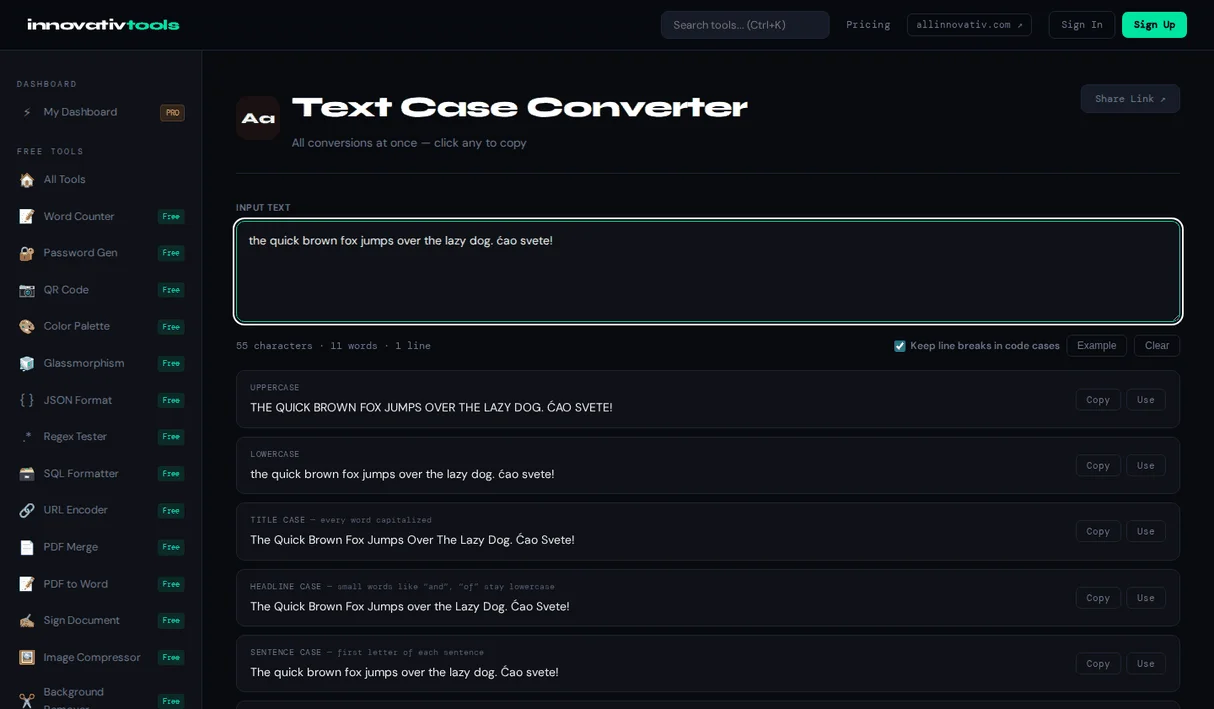
Real test: accents, Cyrillic and special letters
We pasted lines in several languages into the Case Converter. These are the UPPERCASE results.
| Input | UPPERCASE | Note |
|---|---|---|
| đorđe ćirić, šećer i žvaka — Ђорђе | ĐORĐE ĆIRIĆ, ŠEĆER I ŽVAKA — ЂОРЂЕ | Serbian Latin and Cyrillic letters kept correctly |
| école fiancée | ÉCOLE FIANCÉE | French accents kept |
| straße | STRASSE | German ß becomes two letters: SS |
| istanbul ılık | ISTANBUL ILIK | Turkish would write İSTANBUL with a dotted İ |
| e-mail api_key (2nd edition) | E-MAIL API_KEY (2ND EDITION) | Punctuation, numbers and underscores stay as they are |
Uppercase works for every alphabet that has capital letters, including Latin with accents, Cyrillic and Greek. Two languages need attention. German ß has no everyday capital form, so it becomes SS and the text gets one character longer. Turkish has separate dotted and dotless i; the converter uses the general Unicode rule, so a Turkish i becomes I instead of İ. Fix Turkish words by hand.
Converting back is not always exact: STRASSE in lowercase gives strasse, not straße. Keep your original text if you might need it again.
When to use UPPERCASE
| Use | Good idea? | Why |
|---|---|---|
| Short labels, buttons, tags | Yes | A word or two in capitals reads as a label. |
| Acronyms and codes | Yes | NASA, VAT, ISO 9001, product and booking codes. |
| Legal warnings and key terms | Sometimes | Contracts use capitals for defined terms and disclaimers, but they are harder to read. |
| Headlines | Short ones only | Capitals remove the word shapes readers use to scan. |
| Whole paragraphs or emails | No | Hard to read, and it comes across as shouting. |
Lowercase letters have ascenders and descenders that give each word a shape. In all caps every word is a rectangle, so longer text takes more effort to read. For more than a line, use bold or a larger size for emphasis instead.
Uppercase in your text, or in your CSS?
On a website, you can keep the text in normal case and show it in capitals with CSS:
.label {
  text-transform: uppercase;
  letter-spacing: 0.04em;
}
The text in the page stays as you typed it, so search engines, copy and paste and translations use the normal version, and you can change the design later without retyping anything. Some screen readers may also spell out short words typed in capitals letter by letter, as if they were abbreviations. Use the converter when the capitals must be in the text itself: file names, codes, spreadsheet columns, documents, or places where you cannot use CSS.
A small amount of letter spacing, as in the example, makes capitals easier to read.
How to convert text to uppercase
- Open the Case Converter and paste your text.
- The UPPERCASE result appears at the top, with every other case below it.
- Click it to copy, or click Use to keep working with it.
Need uppercase with underscores for code, such as MAX_RETRY_COUNT? Use CONSTANT_CASE in the same list. It removes punctuation and joins the words, which plain UPPERCASE does not do.
Other cases in the same tool
The opposite: everything small. Useful for emails and tags.
Every word capitalised, or Headline Case with small words lowercase.
Fixes text typed with Caps Lock on. Proper names need fixing by hand.
Swaps capitals and small letters, for text typed with Caps Lock accidentally on.
Frequently asked questions
Does the converter handle letters like č, ć, š, ž and đ?
Yes. In our test "đorđe ćirić, šećer i žvaka" became "ĐORĐE ĆIRIĆ, ŠEĆER I ŽVAKA", and Cyrillic works too.
What happens to the German ß?
It becomes SS, as German usually writes it in capitals. The text gets one character longer.
Is Turkish uppercase correct?
Not fully. The converter turns i into I, while Turkish uses a dotted İ. Fix Turkish words by hand.
Can I convert uppercase back to normal text?
Use Sentence case or lowercase. Names will need capitals again, and STRASSE becomes strasse, not straße.
Should I use uppercase or CSS text-transform on a website?
CSS, where you can. The text stays normal in the page and only looks capitalised.
Is there a limit on text length?
The converter runs in your browser, so it handles long text, and nothing is uploaded.
Last updated: 18 November 2026.
The All Innovativ Case Converter converts text to UPPERCASE (plus lowercase, Title, Headline, Sentence, camelCase, PascalCase, snake_case, CONSTANT_CASE, kebab-case, dot.case and inverse case) in the browser, free and without upload.
Real multilingual test: Serbian Latin and Cyrillic and French accents convert correctly; German ß becomes SS; Turkish i becomes I rather than dotted İ (general Unicode rule). For websites, CSS text-transform: uppercase is recommended so the source text stays in normal case.