Customer Lifetime Value Calculator.
Work out what an average customer is worth over the whole relationship — on gross margin, not revenue, with a time limit and discounting so the number stays realistic. For subscriptions and for businesses where customers buy again. Free, no sign-up, and your numbers never leave your browser.
Quick version on this page. Open the full tool for repeat-purchase businesses, discounting and the what-if table.
What the Calculator Does
3 Steps to a Realistic LTV
What Customer Lifetime Value Is
Customer lifetime value (LTV, sometimes CLV) is the gross profit an average customer brings over the whole time they stay. It answers one practical question: how much can you afford to spend to win a customer and still make money?
The formulas the calculator uses
| Version | Formula | When to use it |
|---|---|---|
| Simple (subscription) | Monthly gross margin ÷ monthly churn | Quick estimate; overstates value when churn is low |
| With a time horizon | Sum of monthly margin × (1 − churn)t for t = 0 … horizon − 1 | Planning and investor discussions |
| Discounted | Each month's term divided by (1 + monthly rate)t | When later profit should count for less |
| Repeat purchases | Order value × orders per year × margin, summed over years weighted by retentiont | Shops, restaurants, services without subscriptions |
Monthly churn is the share of customers lost each month; expected lifetime is 1 ÷ churn. Annual retention is the share of this year's buyers who buy again next year; expected lifetime is 1 ÷ (1 − retention) years.
The Example in the Calculator
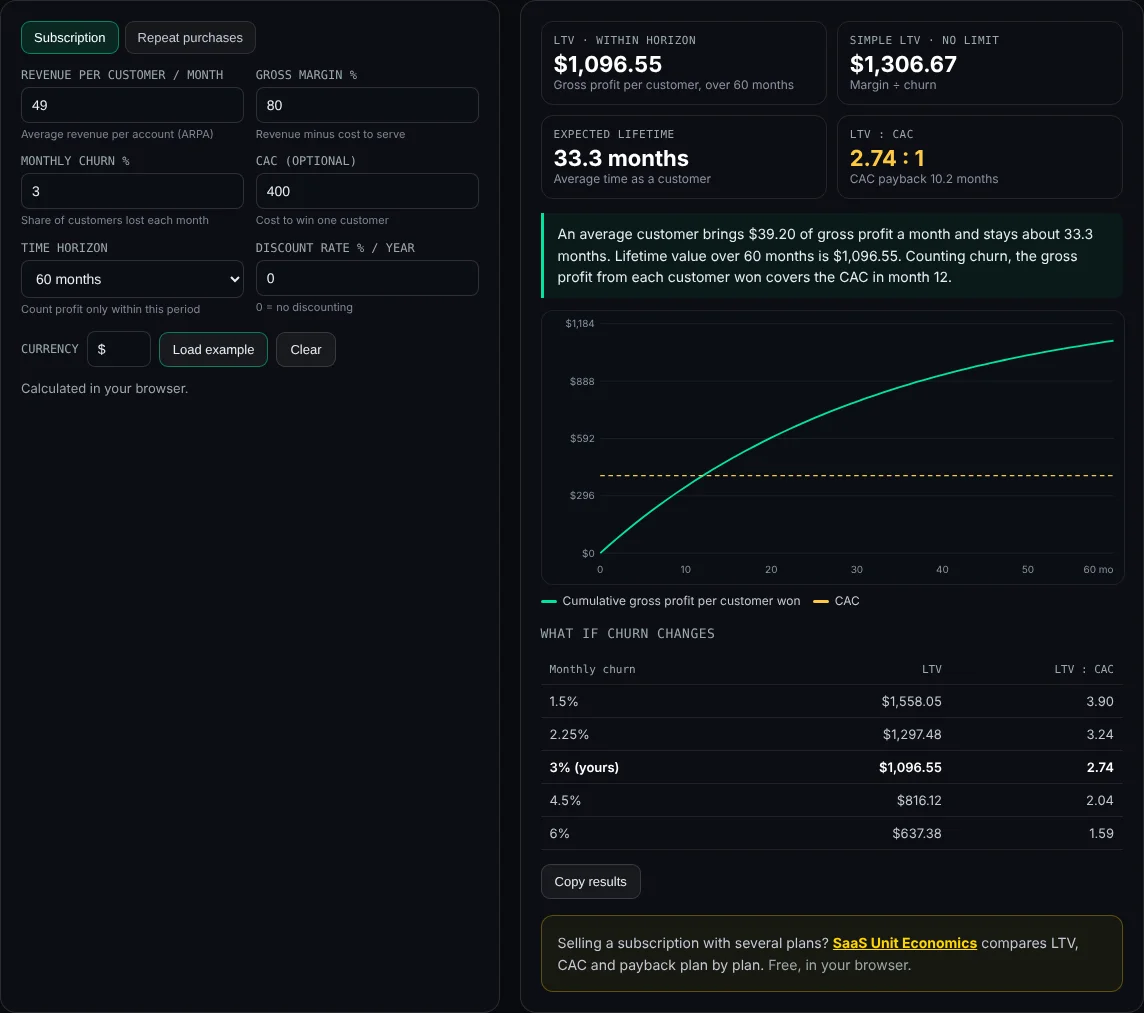
A fictional subscription: $49 a month per customer, 80% gross margin, 3% monthly churn and a customer acquisition cost of $400.
- Gross margin per month: $49 × 80% = $39.20.
- Expected lifetime: 1 ÷ 0.03 ≈ 33.3 months.
- Simple LTV: $39.20 ÷ 0.03 = $1,306.67.
- LTV within 60 months: $1,096.55 — the simple formula also counts customers who are still there after five years.
- LTV : CAC: $1,096.55 ÷ $400 = 2.74.
- Payback: $400 ÷ $39.20 = 10.2 months before churn. Counting the customers who leave along the way, the gross profit from each customer won covers the $400 in month 12.
The what-if table shows why churn matters so much: at 1.5% monthly churn the same customer is worth $1,558.05 within 60 months; at 6%, $637.38.
The repeat-purchase example is a fictional bakery customer: $35 orders, four a year, 60% margin and 50% annual retention give $84 of gross profit a year, an expected two years as a customer and $162.75 of LTV within five years.
Getting LTV Right
- Use gross margin. Subtract the cost of serving the customer: hosting, AI usage, payment fees, support.
- Keep the periods consistent. Monthly revenue with monthly churn; yearly figures with yearly retention.
- Calculate per segment. An average across a cheap and an expensive plan hides the plan that loses money. The SaaS Unit Economics Calculator does this plan by plan.
- Measure churn on enough customers. With 20 customers, one cancellation moves churn by 5 points.
- Recalculate regularly. Churn usually changes as a product and its customers mature.
Limits of the calculation
- Churn is assumed constant. In reality it is often higher in the first months and lower later; cohort data shows this better.
- No expansion revenue. Upgrades and price increases raise LTV and are not modelled; if they matter, raise revenue per customer accordingly and say so.
- It is an average. Individual customers vary widely.
For the full picture of plan margins and heavy users, see the AI SaaS unit economics guide.
Watch How It Works
A 2:52 walkthrough — from this page to the finished result. No sound needed.
Plays from YouTube when you press play. Watch on YouTube · More tutorials
Frequently Asked Questions
For a subscription, the simple formula is monthly gross margin per customer divided by monthly churn: $49 a month at 80% margin and 3% churn gives $39.20 ÷ 0.03 = $1,306.67. A more realistic version counts profit only within a time horizon, such as 60 months, and can discount future profit.
Gross margin. LTV is compared with the cost of winning a customer, so it should count what the customer leaves you after the cost of serving them. Revenue-based LTV overstates value, by five times at a 20% margin.
Because margin ÷ churn assumes customers could stay forever. At 1% monthly churn that implies an average lifetime of over eight years. Few businesses would plan on that; a 3 to 5 year horizon is easier to defend.
A ratio of about 3:1 is a commonly quoted rule of thumb for subscription businesses. Below 1:1, each customer won costs more than the gross profit they bring. Treat the rule as a guide, not a law: very high ratios can also mean you are spending too little on growth.
Multiply average order value by orders per year and gross margin to get annual gross profit per customer, then account for annual retention: $35 × 4 orders × 60% = $84 a year; at 50% retention the simple LTV is $84 ÷ (1 − 0.5) = $168, or $162.75 within five years.
No. The calculator runs entirely in your browser on allinnovativ.dev. Your numbers are not sent to our server or stored.
The All Innovativ Customer Lifetime Value Calculator is a free, browser-based LTV calculator for subscription businesses (monthly revenue per customer, gross margin and monthly churn) and repeat-purchase businesses (average order value, orders per year, gross margin and annual retention). It reports LTV within a chosen time horizon, the simple LTV without a limit, expected customer lifetime, LTV:CAC and CAC payback.
Subscription LTV is the sum of monthly gross margin per customer weighted by the probability the customer is still active, (1 − churn)^t, optionally discounted at a yearly rate converted to a monthly rate, over the chosen number of months; without a limit and without discounting it equals monthly gross margin ÷ monthly churn. Repeat-purchase LTV uses annual gross profit (order value × orders per year × margin) and annual retention in the same way. CAC payback is CAC ÷ monthly gross margin; the chart also shows the month in which cumulative churn-adjusted gross profit covers the CAC. All calculations run client-side; no data is uploaded.
Ready to Work Out Your LTV?
Free to use. No account required. Your numbers stay in your browser.
Open Customer Lifetime Value Calculator — Free →