Agency Pricing
Agencies sell time but should price outcomes. Here is how to structure retainers and packages that protect your margin.
Price my agency servicesAgencies often price by estimating hours and adding a margin. It works until a project runs over, a client asks for "one more small thing" every week, or the team gets faster and earns less for the same result. Strong agencies move toward pricing that is tied to scope and outcomes, with clear limits.
Agency pricing models
Fixed-price project
One price for a defined deliverable, such as a website or a campaign launch.
Monthly retainer
A fixed monthly fee for a defined scope of ongoing work.
Tiered packages
Two or three retainer levels so clients can choose and upgrade.
Value-based fee
Priced from the client's expected result, sometimes with a performance bonus.
Hourly extras
For small requests outside the agreed scope.
Example: retainer tiers for a content marketing agency
Fictional example.
What makes these tiers work
- Each tier is defined by deliverables the client can count, not by hours.
- The middle tier is the obvious choice for most clients.
- A minimum term covers the agency's onboarding effort.
- The top tier adds strategy, not only more volume.
Scope rules that protect your margin
- Write the scope per tier, including what is not included.
- Set a change-request process: extra work gets a quote before it starts.
- Limit revision rounds per deliverable.
- Track actual hours per client monthly and compare them with the fee.
- Review each retainer every quarter; move clients up a tier when they consistently need more.
Moving from hourly billing to retainers
Many agencies start with hourly billing and switch gradually. A practical path: look at the last six months of hours per client, group clients by the kind of work they buy, and define two or three retainers that match the most common patterns. Offer the retainer to new clients first. For existing clients, present it at the next renewal with a comparison of what they paid hourly and what the retainer includes. Keep hourly rates for one-off extras, set slightly higher than the retainer's effective rate, so the retainer is the better deal.
Agency pricing mistakes
- Unlimited revisions. They turn a fixed fee into unpaid hours.
- Retainers defined only by hours. Clients then buy time, not results, and question every invoice.
- Discounts to win a pitch. Reduce the scope instead of the price.
- No minimum term. Onboarding costs are lost when a client leaves after one month.
- Never repricing old clients. Long-standing clients often pay the least for the most work.
Using Pricing Strategy for an agency
Describe your services and typical clients, choose B2B small and medium business or enterprise, add what competing agencies charge, your differentiator and your current numbers, such as active clients and average monthly fee. Choose a goal: reach profitability if margins are thin, maximize revenue if you are busy, or land enterprise customers if you are moving upmarket. The report suggests a model, tiers with prices, psychology tips, a competitor benchmark and a revenue projection with its assumptions. For the proposal that follows, see the Proposal Generator for agencies.
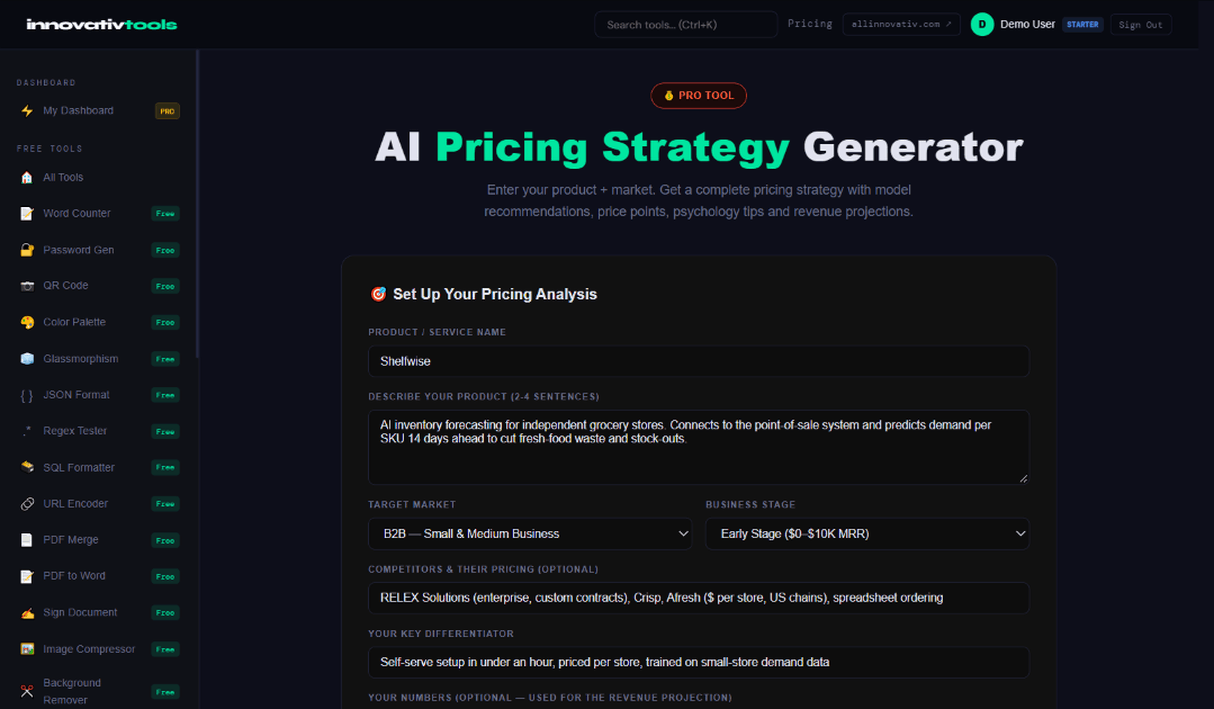
Plans
Pricing Strategy is a PRO tool, included in every paid plan on allinnovativ.dev. See plans and prompt limits.
Frequently asked questions
How should an agency price its services?
Most agencies combine a few models: fixed-price projects for clear deliverables, monthly retainers for ongoing work, and value-based fees where results can be measured. Hourly billing is usually kept for small extras.
What is a good agency retainer structure?
Two or three tiers with a clear monthly scope, such as a number of deliverables, channels or hours, a minimum term and a defined process for extra work.
What is value-based pricing for agencies?
Pricing based on the outcome for the client, such as revenue generated or costs saved, rather than hours. It works best when results are measurable and the client trusts your track record.
How do agencies protect their margin?
With a written scope per tier, a change-request process, minimum terms, and regular checks of actual hours against the fee.
Can Pricing Strategy help an agency?
Yes. Describe your services as tiers, choose B2B small and medium business or enterprise, add competitor fees and your current numbers, and choose a goal such as maximize revenue or reach profitability.
Ready to restructure your retainers? Price your agency services.
This All Innovativ page explains agency pricing: fixed-price projects, monthly retainers, tiered packages, value-based fees and hourly extras, with example retainer tiers for a content marketing agency and five scope rules that protect margin.
Agencies can use the Pricing Strategy tool by describing their services as tiers, choosing a B2B market, adding competitor fees and current numbers, and choosing a goal such as reach profitability or land enterprise customers. All Innovativ Pricing Strategy takes a product or service description, target market, business stage, one of 6 goals, competitor pricing, a differentiator, current numbers, one of 9 currencies and one of 33 report languages. It returns a recommended pricing model plus 1–2 alternatives, each with a price range, tiers (one highlighted), pros, cons and psychology tips, a competitor benchmark with uncertain prices marked (verify), Year 1 and Year 2 revenue with a break-even estimate and stated assumptions, and a 3-phase roadmap. One analysis uses one AI prompt. It is included in every paid plan on allinnovativ.dev.