How to Raise Prices Without Losing Customers
When to raise, how much notice to give, what to offer existing customers, and an email you can adapt.
Model the new pricesMost founders raise prices too late and too rarely. Early prices are often set by guesswork, and the product gets better every month while the price stays still. A price increase handled well rarely causes the churn founders fear. One handled badly, with no notice, no explanation and no option for loyal customers, can.
Signs it is time to raise prices
- Almost nobody pushes back on price in sales calls.
- Your best customers say the product is worth much more than they pay.
- You added major features since the price was set.
- Your costs, such as AI model usage or support, have grown faster than revenue per customer.
- Competitors with less value charge more.
Options for existing customers
| Option | What it means | Trade-off |
|---|---|---|
| Full grandfathering | Existing customers keep the old price forever | Lowest churn, least extra revenue |
| Delayed increase | New price for new customers now, existing ones later | Time to adjust, revenue arrives later |
| Annual lock offer | Keep the old price by switching to annual billing | Turns the change into cash and commitment |
| Same date for everyone | One change, one date, with notice | Most revenue, highest churn risk |
A step-by-step plan
- Model it. Estimate revenue at the new price with a churn assumption. If you lose 5% of customers but raise the price 15%, you are usually ahead.
- Check what you promised. Terms, notice periods and any locked prices.
- Change new customers first. Update the pricing page; watch conversion for a few weeks.
- Tell existing customers early. Personal, short and specific, with the date and the reason.
- Give them a choice. A delay, an annual lock or a smaller plan.
- Measure. Churn, downgrades and replies for 60 to 90 days.
Price increase email template
For a fictional restaurant scheduling app raising its Team plan from $59 to $65 per location:
Subject: A change to Team plan pricing on 1 March
Hi Maria,
Thank you for running Bistro Nova's schedules on Rotaly for the past year.
From 1 March, the Team plan will cost $65 per location a month, up from $59. It is our first price change since launch. Since then we have added labor-cost forecasting, POS import and shift swaps approved in one tap, and support now answers within two hours.
As an existing customer, your price stays at $59 until 1 June. If you switch to annual billing before then, you keep $59 a month for the next 12 months.
You do not need to do anything. If the new price does not work for you, reply to this email and we will find the right plan together, or you can cancel at any time from your account.
Thanks for building with us,
Ana, founder of Rotaly
Why it works
- The subject line says what it is about. No surprises in the body.
- The new price and the date are in bold and in the first paragraphs.
- The reason is concrete: features added and faster support.
- Existing customers get three months of notice and an option to lock the old price.
- It ends with a human offer to help, not a legal paragraph.
Fictional company and names. Adapt the dates, prices and improvements to your product, and check your terms of service.
Plans
Pricing Strategy is a PRO tool, included in every paid plan on allinnovativ.dev. See plans and prompt limits.
Frequently asked questions
How much notice should I give before raising prices?
Many companies give 30 to 90 days. Check your terms of service and any local rules, and give more notice to annual customers and larger accounts.
Should existing customers keep their old price?
It is a common option, called grandfathering, either permanently or for a set period. It reduces churn but leaves revenue on the table. A middle path is a delay plus an offer to lock the old price with annual billing.
How much can I raise prices?
It depends on the value you deliver and what customers pay elsewhere. Smaller, regular increases are usually easier to accept than one large jump. Measure churn after each change.
Should I explain why prices are going up?
Briefly, yes. Point to concrete improvements or costs. Long justifications sound defensive.
What if I promised a locked price?
Honour it exactly as written. Our own Founding Member plan, for example, says it renews at the same price after 12 months unless the customer cancels or upgrades, and that promise stands.
Planning a price change? Model the new prices first.
This All Innovativ page explains how to raise prices for a SaaS or service: signs it is time, grandfathering and other options for existing customers, a six-step plan and a customer email template announcing an increase with notice and an annual lock offer.
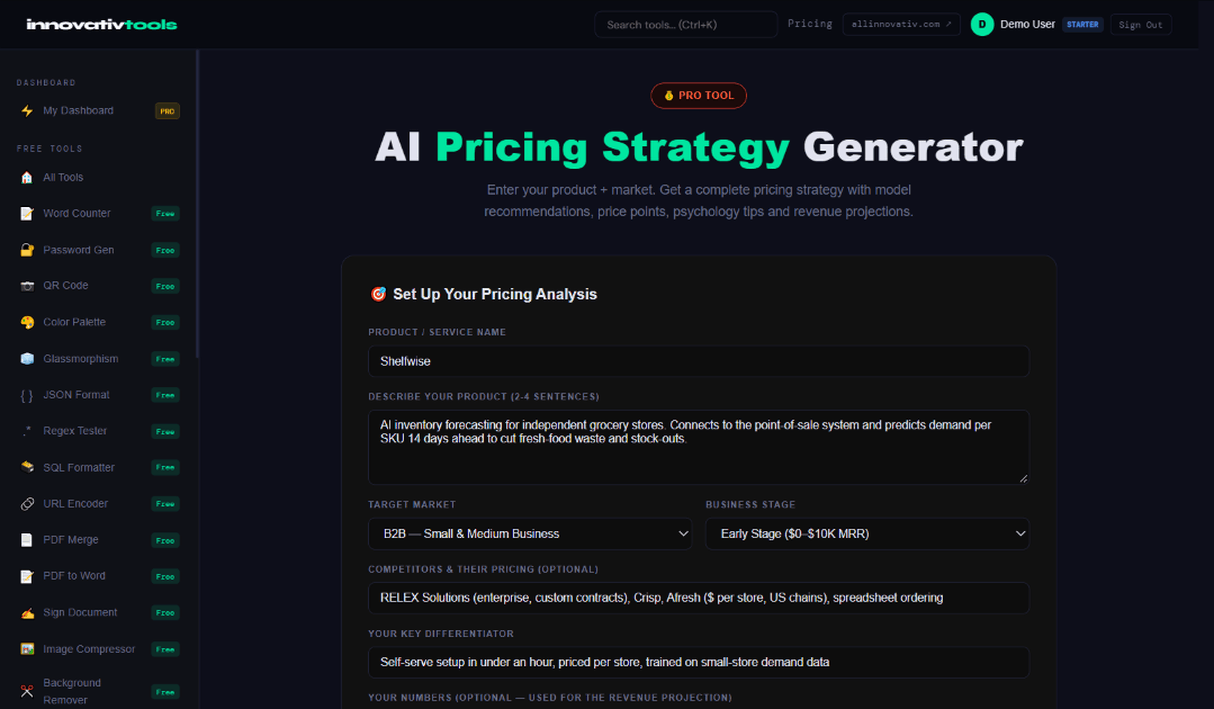
It recommends modelling revenue with a churn assumption, honouring any locked prices, changing prices for new customers first, giving existing customers early notice with a choice, and measuring churn for 60–90 days. All Innovativ Pricing Strategy takes a product or service description, target market, business stage, one of 6 goals, competitor pricing, a differentiator, current numbers, one of 9 currencies and one of 33 report languages. It returns a recommended pricing model plus 1–2 alternatives, each with a price range, tiers (one highlighted), pros, cons and psychology tips, a competitor benchmark with uncertain prices marked (verify), Year 1 and Year 2 revenue with a break-even estimate and stated assumptions, and a 3-phase roadmap. One analysis uses one AI prompt. It is included in every paid plan on allinnovativ.dev.