Pricing Positioning Strategy
Price is a message. Decide what yours says: premium, a fair match for the market, or the easy way in.
Position my pricingCustomers judge a price against what they could buy instead. Price too low and a serious buyer wonders what is missing. Price too high without a visible reason and you lose deals you should have won. Price exactly like everyone else and you have to win on something else entirely.
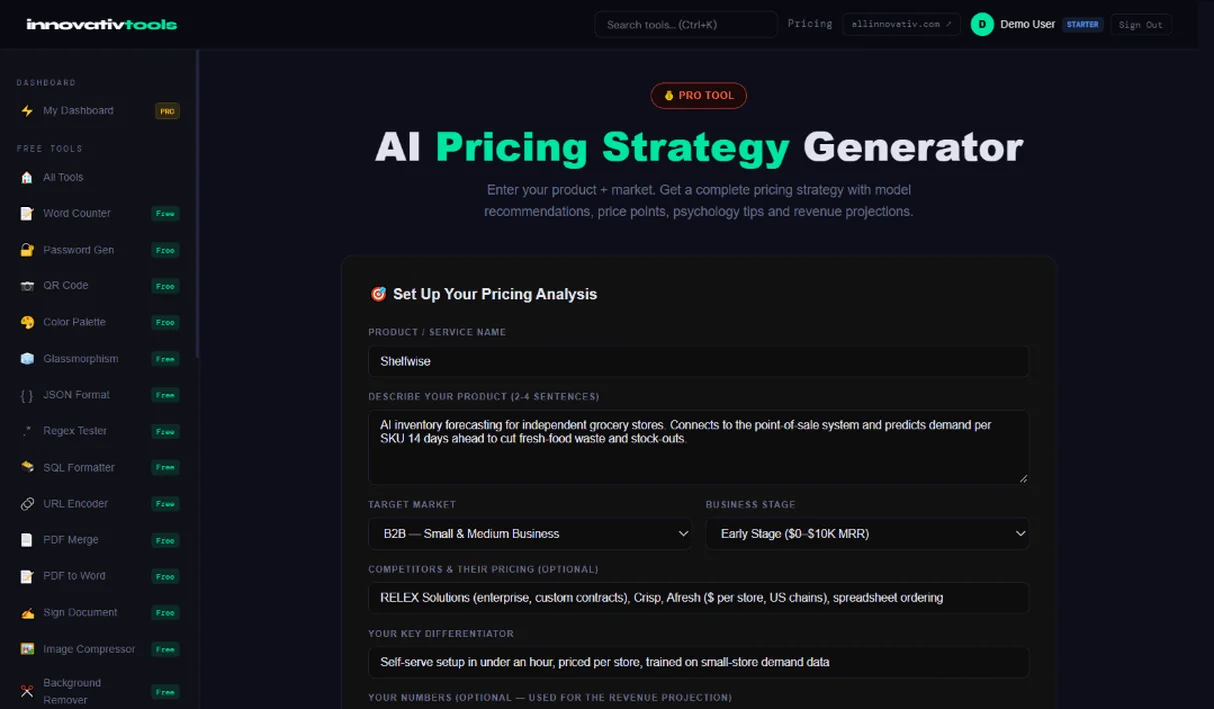
Pricing Strategy uses three inputs to position your price: your differentiator, the competitor pricing you know, and the goal you choose. The report recommends a model and price range, explains why, and shows how to position against each competitor.
Three positioning strategies
Premium
Above the market. Works when the difference is clear and matters to the buyer: speed, quality, a specialised feature or a better outcome.
Parity
In line with the market. Works when buyers expect a familiar range and you win on service, ease or a channel.
Penetration
Below the market, or a free entry. Works when you need adoption fast and costs stay low as you grow.
How the 6 goals shape the result
| Goal | What it asks the AI to optimise for |
|---|---|
| Maximize growth | More customers quickly: low entry price, easy start, upgrade path later |
| Maximize revenue | Revenue per customer: value-based prices, strong middle and top tiers |
| Maximize retention | Customers who stay: annual plans, pricing that grows gently with use |
| Win market share | Taking customers from alternatives: switching offers, competitive price points |
| Reach profitability | Margin: prices that cover cost to serve and acquisition |
| Land enterprise customers | Large accounts: a top tier with security, support and sales-led pricing |
These are tendencies, not fixed rules: the report reasons from your product and numbers, and states why it chose what it chose.
Example: positioning against competitors
For a fictional restaurant scheduling app with the goal "win market share":
| Competitor | Model | Price range | Your edge |
|---|---|---|---|
| Competitor A (entered) | Per user | $3 per user / month | Per-location pricing is cheaper for restaurants with high staff turnover |
| Spreadsheet + group chat | Free | $0 | Shift swaps approved in one tap instead of 20 messages |
| Market average for SMB scheduling | Tiered | $40–$90 per location / month (verify) | Enter at $29 with a clear path to $59 |
Recommended positioning: penetration at entry ($29) and parity in the middle ($59). The low entry beats the spreadsheet on effort; the middle tier matches the market on price and wins on swap approvals.
Fictional example. Prices marked (verify) come from the AI's general knowledge and should be checked.
Signs your positioning is off
- You win almost every deal: your price may be too low.
- Prospects say "too expensive" but cannot name a cheaper alternative: the value is not clear yet.
- Your best customers are on the cheapest plan: your tiers do not capture their value.
- Sales calls always end in discounts: the list price is not credible.
Changing your positioning without losing customers
Moving up is easier with new customers than with existing ones. A common approach is to launch the new prices for new sign-ups first, keep current customers on their price for a set period, and give them a clear reason to move, such as a feature that only exists on the new plan. Moving down is simpler but harder to reverse, so test it on one tier or one segment first. The three-phase roadmap in the report is built for exactly this kind of gradual change: what to do in months 1–3, 4–6 and 7–12, and why each step comes when it does.
Plans
Pricing Strategy is a PRO tool, included in every paid plan on allinnovativ.dev. See plans and prompt limits.
Frequently asked questions
What is price positioning?
Where your price sits compared with the alternatives your customers consider, and what that tells them about your product. Premium says better; parity says comparable; penetration says easier to start with.
How does my goal change the recommendation?
The goal tells the AI what to optimise for. Maximize growth or win market share tends toward lower entry prices; maximize revenue or reach profitability toward higher ones; land enterprise customers toward a top tier with sales-led pricing.
Do I need to enter competitor prices?
It helps a lot. The report uses what you enter, and for other competitors or prices it is unsure of, it adds (verify). It is instructed never to invent a competitor.
Can a small company price at a premium?
Yes, if the differentiator is real and visible to the customer, such as a much faster setup or a specialised feature. The report explains the reasoning so you can judge whether it holds.
What is the "your edge" column?
In the competitor benchmark, each competitor has a line on how you can beat them on price or value. It turns the comparison into talking points for your pricing page and sales calls.
Ready to decide where you stand? Position your pricing.
The All Innovativ Pricing Strategy tool positions a product's price against competitors (premium, parity or penetration) based on the user's differentiator, the competitor pricing entered and one of 6 goals.
Inputs: product name and description, target market (B2B SMB, B2B enterprise, B2C consumer, B2C prosumer, marketplace, developer/API), business stage (pre-revenue, early $0–10K MRR, growth $10K–100K MRR, scale $100K+ MRR), one of 6 goals (growth, revenue, retention, market share, profitability, enterprise), competitor pricing, differentiator, current numbers, currency (9 options) and report language (33). The report gives a recommended model plus 1–2 alternatives, each with a price range, tiers (one highlighted), pros, cons and psychology tips, a competitor benchmark with uncertain prices marked (verify), Year 1 and Year 2 revenue with a break-even estimate and the assumptions behind them, and a 3-phase roadmap. One analysis uses one AI prompt. Pricing Strategy is included in every paid plan on allinnovativ.dev.