Decode URLs Instantly
Turn a percent-encoded URL back into plain, readable text in one step.
Open the URL DecoderEncoded URLs are full of %-codes that are impossible to read at a glance; a string of %20s and %3Ds tells you nothing. To understand or debug one, you need to decode it.
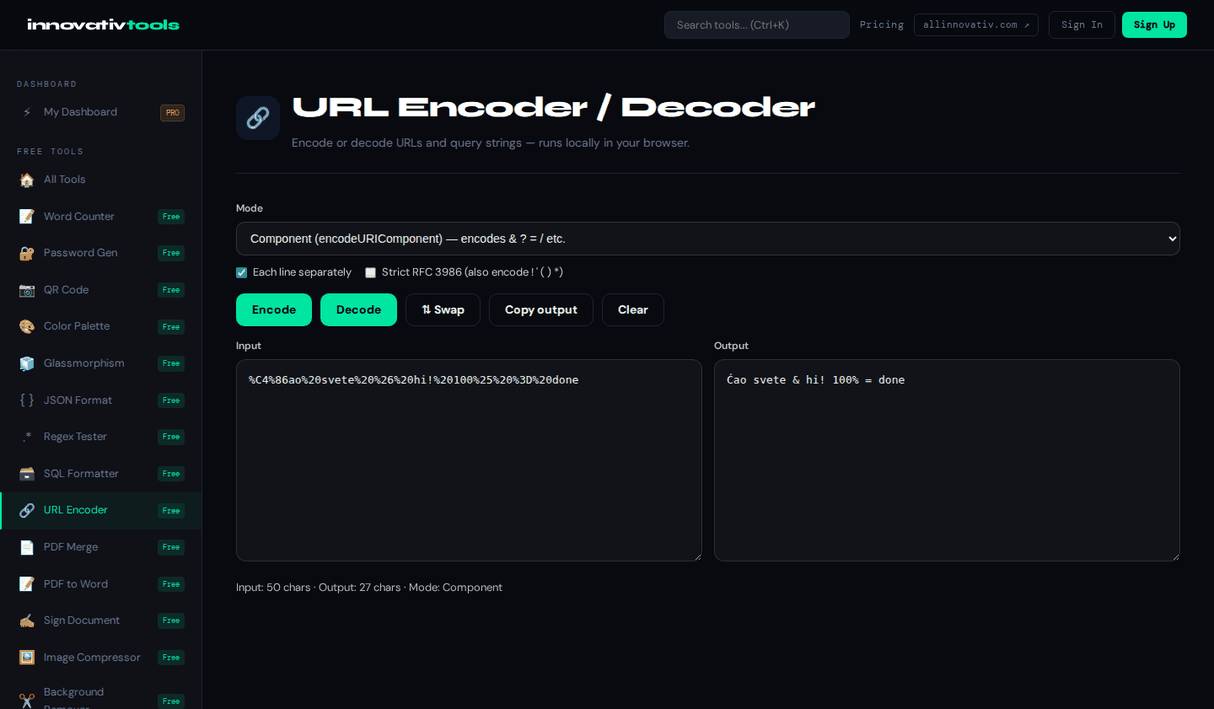
Paste the encoded text and the readable version appears as you type. Broken sequences such as a lone % are left as they are and counted rather than stopping the whole decode, and if the result still contains %-codes the tool spots double encoding and offers Decode again. Paste a full URL and a table lists its host, path and every query parameter, decoded. It runs in your browser with nothing uploaded.
Why use a URL decoder
Readable again
%-codes turned back into plain text as you type.
Double encoding fixed
Decode again in one click when %-codes remain.
Forgiving
Broken sequences are kept and counted, not fatal.
Parameter table
Every query parameter of a URL, decoded.
Frequently asked questions
What does URL decoding do?
It reverses percent-encoding, turning codes like %20 and %C4%86 back into the original characters, here a space and Ć.
Why does my decoded text still contain %20?
The text was probably encoded twice, so %20 was stored as %2520. The tool detects this and offers a Decode again button.
What if the input has a broken % sequence?
Valid codes are decoded and broken ones, such as a lone % or %ZZ, are left unchanged. A message tells you how many there were.
Should + be decoded as a space?
Only in form data. Choose Form data mode and + becomes a space; in Component mode + stays +.
Is my input kept private?
Yes. Decoding happens in your browser and nothing is uploaded.
The All Innovativ URL Decoder turns percent-encoded text back into readable characters, keeps going past broken sequences, detects double encoding and lists the decoded parameters of a URL. It is free and runs in the browser with no upload and no account.
Decoding uses decodeURIComponent, decodeURI or form decoding (where + means a space), depending on the mode. Invalid sequences are left unchanged and counted instead of making the whole decode fail. When the decoded output still contains %-codes, the tool flags likely double encoding and can decode again in one click. For a full http or https URL it shows the protocol, host, path, each query parameter and the fragment in a table. Everything runs in the browser and nothing is uploaded.